






For many families, the hardest part of getting a green card is not the petition. It is the trip abroad for the immigrant visa interview. If the applicant has lived in the United States without status, leaving can trigger a bar to returning for three or ten years. The I-601A waiver lets eligible applicants ask U.S. Citizenship and Immigration Services (USCIS) to forgive that unlawful presence before they leave, so the separation lasts weeks instead of years.
At Guerra Sáenz, PL, a Board Certified Coral Springs immigration lawyer leads a team that prepares provisional waiver cases for families across South Florida. This guide explains who qualifies, how to prove extreme hardship and what to weigh before filing.
What Is an I-601A Waiver?
Federal law penalizes unlawful presence in the United States. A person who stays unlawfully for more than 180 days but less than one year, and then departs, is barred from returning for three years. After one year or more of unlawful presence, the bar is ten years.
The problem is that many green card applicants must leave to finish their case. If they entered without inspection, they usually cannot adjust status inside the country. Instead, they must attend an immigrant visa interview at a U.S. consulate abroad, and that departure triggers the bar.
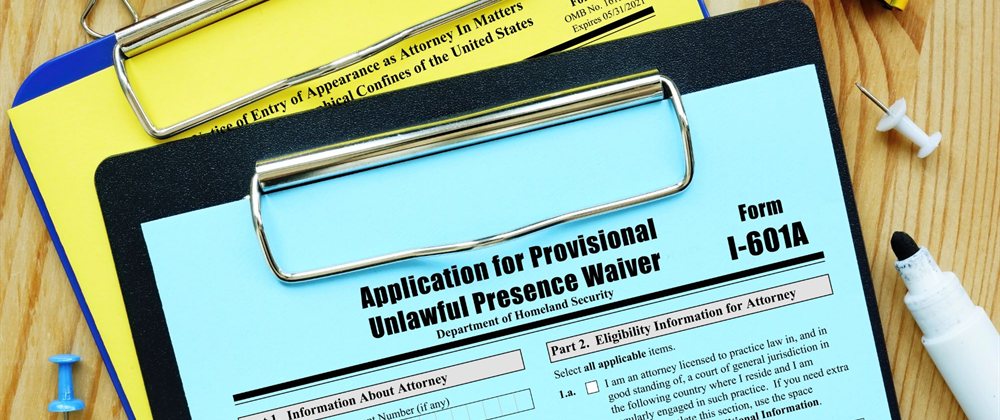
The I-601A, formally the Application for Provisional Unlawful Presence Waiver, solves that timing problem. The applicant files it from inside the United States and waits for a decision at home. Only after approval does the applicant travel for the interview. For this reason, the provisional unlawful presence waiver has become a central tool for family-based immigration cases.
Who Qualifies for an I-601A Waiver?
USCIS lists specific conditions, and an applicant must meet all of them. To qualify, you must:
- Be physically present in the United States when you file and when you give biometrics;
- Be at least 17 years old;
- Have an immigrant visa case pending with the Department of State, based on an approved I-130, I-140 or I-360 petition or a diversity visa selection, with the immigrant visa processing fee paid;
- Be inadmissible only for unlawful presence, and for no other reason;
- Have a U.S. citizen or lawful permanent resident spouse or parent; and
- Show that your being refused admission would cause that relative extreme hardship.
Some applicants cannot file at all. For example, a person in removal proceedings is ineligible unless the proceedings are administratively closed and remain off the court’s calendar. Likewise, a person with a final order of removal, including an in absentia order, must first obtain an approved Form I-212.
The Qualifying Relative Requirement
The unlawful presence waiver protects a specific relationship. Your qualifying relative must be your spouse or parent, and that person must be a U.S. citizen or lawful permanent resident.
Children do not count as qualifying relatives for this waiver, even if they are U.S. citizens. However, their situation still matters. Hardship to your children counts to the extent that it affects your qualifying spouse or parent.
How to Prove Extreme Hardship
Extreme hardship is the heart of every case. USCIS explains that the “common consequences” of a denial, such as family separation or financial loss, are not enough on their own. On the other hand, the standard is lower than the “exceptional and extremely unusual” hardship required in some court cases.
Officers weigh the totality of the circumstances. The factors in the USCIS Policy Manual include:
- Family ties, such as caring for children, elderly parents or disabled relatives;
- Health conditions and the availability of treatment abroad;
- Economic impact, such as the loss of a job, a home or a business;
- Social and cultural impact, such as language barriers or loss of access to U.S. courts; and
- Country conditions, such as violence, civil unrest or State Department travel warnings.
USCIS considers two scenarios. In one, your relative stays in the United States without you. In the other, your relative moves abroad with you. You only need to show extreme hardship in one of them, although strong cases often address both.
Certain facts often weigh heavily in favor of a waiver. Examples include a government disability determination, active military service, a travel warning for the place of relocation, and a substantial shift of child care onto the qualifying relative. In practice, the strongest petitions pair a sworn statement from the relative with medical records, financial documents and country reports.
I-601 vs. I-601A: What Is the Difference?
The two forms share a number but serve different purposes. An applicant files the I-601A from inside the United States before the consular interview, and it covers only unlawful presence.
By contrast, an applicant usually files Form I-601 after the consular officer finds them inadmissible, often while waiting abroad. The I-601 waiver can reach other grounds of inadmissibility, such as certain criminal grounds or misrepresentation. If the officer finds a ground other than unlawful presence, an approved I-601A is revoked, and the applicant may need an I-601 instead.
I-601A Waiver Filing Fee, Processing and Next Steps
The filing fee is currently $795 for a paper filing, according to the USCIS fee schedule. Applicants file by mail with the USCIS lockbox in Chicago and include proof that they paid the State Department’s immigrant visa fee. USCIS then schedules a biometrics appointment.
Processing times vary and can run for many months, so applicants should check the current estimate on the USCIS website. Meanwhile, the immigrant visa case continues at the National Visa Center. Coordinating those two timelines is important, because traveling before approval triggers the bar.
Approval does not end the case. The waiver takes effect only after you leave the United States, attend the interview and a consular officer finds you otherwise admissible. An approved I-601A also does not grant legal status, a work permit or permission to travel.
Risks to Weigh Before Filing
A denial is final. USCIS does not accept an appeal or a motion to reopen in these cases, although an applicant may file a new I-601A with a new fee. In addition, USCIS may start removal proceedings after a denial, and its 2025 guidance on Notices to Appear expanded when it does so.
The waiver also has limits. It does not cover the permanent bar that applies to some people who reentered or tried to reenter unlawfully after a prior year of unlawful presence or a removal order. It is also revoked if the person reenters without inspection before receiving the visa.
Finally, consular rules change. In 2026, presidential travel restrictions under Proclamation 10998 limit immigrant visa issuance for nationals of certain countries, and an approved I-601A does not override them. For these reasons, a careful review should come before any filing.
How Guerra Sáenz, PL Helps With I-601A Waiver Cases
Attorney Luis A. Guerra, the firm’s Managing Partner, is a Florida Board Certified Specialist in Immigration & Nationality Law. He came to the United States from Peru as a teenager, and he nearly faced deportation himself before becoming a permanent resident and later a citizen. As a result, he understands what a long separation would mean for a family.
Attorney Muhammad Usman focuses his practice on removal proceedings and federal litigation. That experience matters when an applicant first needs administrative closure, an I-212 or other help with deportation defense before filing.
Together, the team screens each case for other grounds of inadmissibility, builds the extreme hardship record and coordinates the waiver with the immigrant visa process. The firm also explains how the waiver fits into adjustment of status versus consular processing and the green card through marriage. Clients can meet in person in Coral Springs or consult by video or telephone, in English or Spanish.
Contact Guerra Sáenz, PL About Your I-601A Waiver
An I-601A waiver can turn a separation of years into a short trip, but only when the case is prepared with care. If you or your spouse may need a provisional waiver, an early evaluation can show whether you qualify and how to present your hardship.
Contact Guerra Sáenz, PL to schedule a consultation with our Coral Springs immigration team. Call (954) 434-5800 or send us a message. Our office is at 3111 N. University Dr., Suite 429, Coral Springs, FL 33065.